Stories
•
September 17, 2026
I Got the Craziest Text Message Today. Then I Realized It Wasn’t Really About Me.

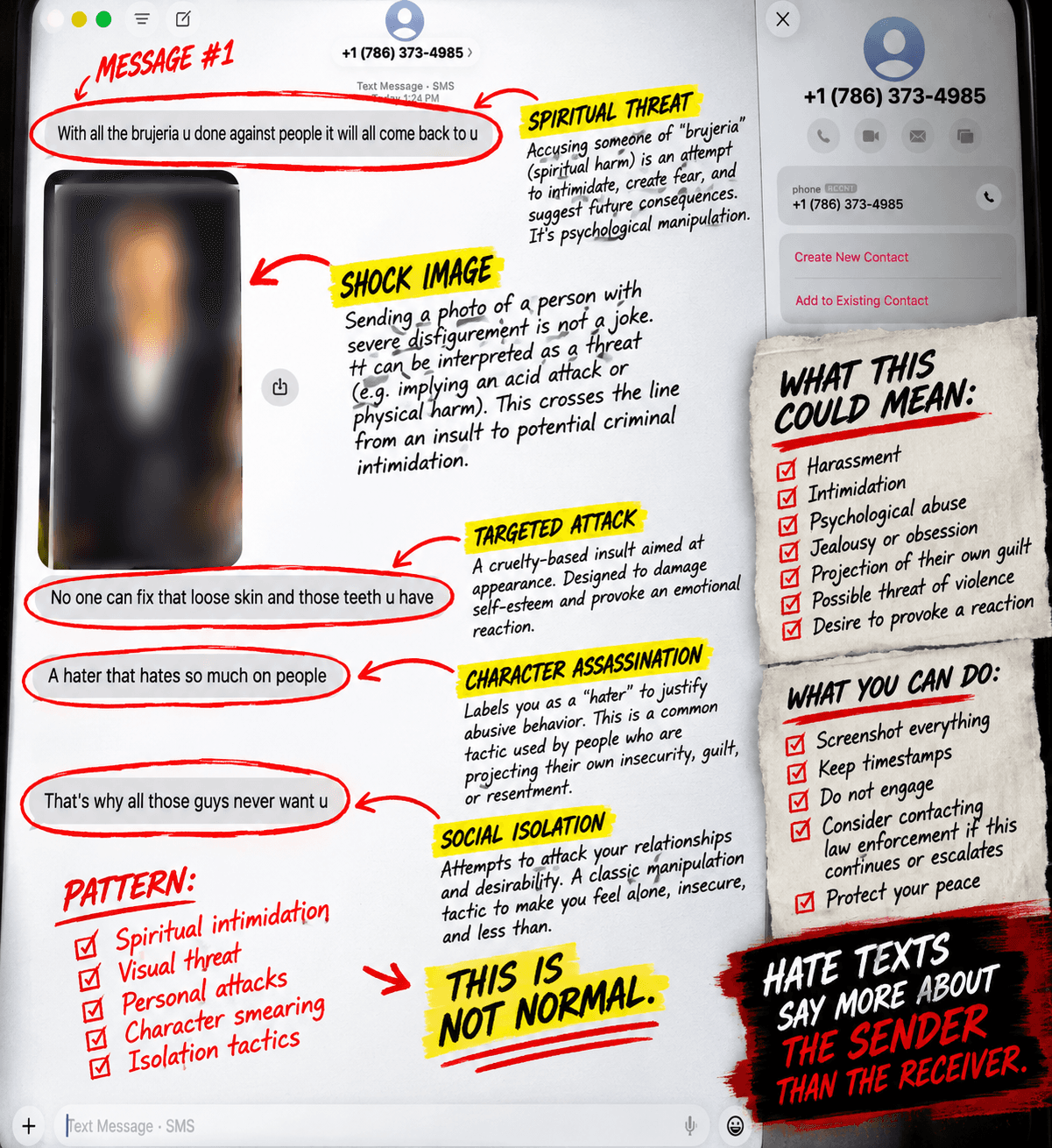
Someone Sent Me a Picture of a Horrifically Disfigured Person and Told Me It Was Coming Back to Me. Then They Called Themselves a Christian.
Before we talk about my teeth, my skin, who supposedly wants me, who does not want me, my Instagram, my personality, or whatever other fragments of my existence somebody has apparently been studying closely enough to develop a syllabus, I have one question.
What exactly do you think Christianity looks like?
Because if your version of Christianity involves sitting somewhere with a phone in your hand, searching for a photograph of another human being who has suffered catastrophic facial injuries, sending that image to somebody you dislike, telling them that everything they have supposedly done is going to “come back” to them, and then following it with insults about their appearance, I think we have discovered a fascinating new denomination.
Apparently the Sermon on the Mount now comes with anonymous SMS.
You can quote Scripture all day. You can say “God” every third sentence. You can wear a cross, post Bible verses, tell everybody you are blessed, talk about karma even though that is not actually Christian theology, and perform righteousness until the lighting crew goes home.
None of that makes cruelty holy.
And morality gets particularly interesting when the person delivering the sermon has serious questions surrounding their own behavior.
If you want to discuss character, then character is fair territory.
If you want to discuss honesty, then honesty is fair territory.
If you want to discuss theft, deception, relationships, loyalty, and the difference between the identity somebody performs publicly and the way they actually behave privately, then perhaps we should make coffee because this conversation may take a while.
There are things I know.
There are things I have seen.
There are things other people know.
And there are things I would never publish casually because, unlike somebody sending grotesque photographs from behind a telephone number, I understand that accusations carry consequences.
That distinction matters.
I am not interested in manufacturing crimes for somebody because I am angry.
I do not have to.
The message you actually sent me is strange enough.
And documented.
That is what makes this entire thing so fascinating.
You wanted me to look at that photograph and think about myself.
Instead, I looked at it and started thinking about you.
Not your name.
Not your face.
Not whatever version of yourself you present to church, family, friends, Instagram, or God.
I started wondering what has to happen inside somebody before another person's mutilation becomes an appropriate prop in a personal argument.
That is a much more interesting question than whether you like my teeth.
And yes, I know more about the person behind this than they probably expected me to know.
But this article is bigger than one person.
Because eventually almost everyone encounters someone like this.
The former friend.
The former lover.
The person you helped.
The person you vouched for.
The person you defended when everybody else was calling them crazy.
The person who borrowed money, contacts, confidence, opportunity, credibility, transportation, introductions, advice, or simply hours of your life.
The person who once sat comfortably at your table and later decided that everything they learned while sitting there could be converted into ammunition.
That is where this story actually begins.
And before anyone tries to diagnose my entire existence from an Instagram account, there is another thing worth explaining.
You Do Not Know Someone Because You Follow Them
My personal Instagram account is not my biography.
It is certainly not my résumé.
I do not wake up every morning and announce that I own businesses.
I do not periodically remind everybody that I went to college.
I do not upload photographs of degrees so strangers can verify that I am educated.
I do not document every professional accomplishment, every project, every business conversation, every meeting, every opportunity, every problem I solved, every person I helped, or every room I have managed to get myself into.
People who actually know me know those things because we have conversations.
My Instagram is something else.
It is an artistic flare of who I am willing to show publicly.
It is loud.
Sometimes ridiculous.
Sometimes provocative.
Sometimes polished.
Sometimes completely fucking unserious.
It has energy because I have energy.
There is nightlife. There is travel. There are weird jokes. There are clothes. There are restaurants. There is vanity because I am a human being with a camera. There is humor. There is chaos. There are moments that make sense only to the five people standing in the room when they happened.
I like that.
I do not need my social media profile to walk into a room wearing a navy suit and introduce itself as Founder and Chief Executive Officer.
Some people do that.
There is nothing wrong with it.
I just don't need to.
But there is a strange consequence to not constantly advertising your credentials.
People fill in the empty spaces themselves.
They see the version you chose to show them and assume it is the entire building.
They see the lobby and believe they have inspected every floor.
Then, amazingly, some of them begin making judgments about your intelligence, your finances, your relationships, your education, your professional life, your future, your desirability, and your worth based on what amounts to a curated handful of photographs on a glowing rectangle.
That is not knowing somebody.
That is fan fiction.
And social media has produced an entire generation of people who confuse access with intimacy.
They watched your Story, therefore they understand your life.
They saw you drunk once, therefore they understand your discipline.
They saw you traveling, therefore they understand your finances.
They saw you being ridiculous, therefore they understand your intelligence.
They saw you being loud, therefore they understand your private personality.
They saw you being quiet, therefore something must be wrong.
People do this because uncertainty makes them uncomfortable.
It is easier to reduce somebody to a character than accept that human beings contain contradictions.
I can be outrageous Saturday night and handle business Monday morning.
I can make a stupid joke and still understand complicated things.
I can enjoy attention without requiring it to survive.
I can be educated without turning my degree into a personality trait.
I can own things without announcing ownership every morning.
I can accomplish something without converting it into motivational content.
And perhaps most importantly, I can have a life that exists completely outside the small window I allow strangers to look through.
That should be obvious.
Apparently it is revolutionary.
And that is precisely why messages like the one I received become so revealing.
Because the sender is not responding to the totality of your life.
They are responding to their construction of you.
A character assembled from photographs, gossip, memories, resentment, fragments of conversations, old arguments, mutual friends, assumptions, insecurity, and whatever information they quietly collected while pretending not to care.
Then they attack the character.
And expect the real person to bleed.
That is where your existing passage can come in almost perfectly:
What messes with you is not always the insult itself...
From there, I would expand the threat section considerably. Something like:
A Photograph of Severe Bodily Harm Changes the Conversation
There is another reason I am not dismissing this as merely somebody being nasty.
The image.
I keep coming back to the image.
Because words are one thing.
“You're ugly.”
Fine.
“Nobody wants you.”
Original.
“Your teeth.”
Devastating. Alert the dental association.
But sending an image of somebody who appears catastrophically burned or disfigured while simultaneously telling another person that what they have done is going to “come back” to them introduces something completely different into the exchange.
Maybe the sender intended shock.
Maybe they intended humiliation.
Maybe they intended intimidation.
Maybe they thought it was hilarious.
I am not inside their head, and I have no interest in pretending I am.
But the recipient does not have to possess telepathy to understand why that imagery might feel threatening.
If somebody sends you a picture depicting horrific bodily injury in the middle of a hostile interaction, it is perfectly reasonable to preserve it and take it seriously.
Especially when the entire purpose of the communication appears to be disturbing you.
A threat does not become harmless simply because it arrived between grammatical errors.
And harassment does not become innocent because only a few messages were sent.
Context matters.
Sequence matters.
Imagery matters.
Intent matters, but so does what a reasonable person receiving the communication might understand from it.
I looked at that picture and thought about acid attacks.
That thought did not materialize because I have an unusually creative imagination.
Acid attacks are a real form of violence whose defining horror is permanent disfigurement.
So when somebody deliberately sends imagery resembling catastrophic facial burning or disfigurement as part of a hostile exchange, I am not going to pretend there is no conceivable threatening implication simply because the sender did not type, in perfect legal English, “I hereby threaten you.”
That is not how human communication works.
People imply things.
People intimidate through imagery.
People use symbols precisely because symbols allow them to communicate something without explicitly spelling it out.
And sometimes the most disturbing part of a threatening interaction is not a sentence.
It is the thing somebody deliberately chooses to show you.
That does not mean I am declaring what crime occurred.
That determination belongs to people whose job it is to make those determinations.
What I am saying is much simpler.
If somebody sends me disturbing imagery of severe bodily harm while directing hostility toward me, I am allowed to document it, preserve it, take precautions, and contact law enforcement if I believe the communication is threatening or escalating.
There is nothing dramatic about that.
It is basic common sense.
I would rather hand somebody a ridiculous screenshot that turns out to mean nothing than explain later why I deleted something disturbing because I was too concerned about appearing “bothered.”
We have developed this bizarre internet culture where people think strength means pretending absolutely nothing affects you.
Someone threatens you?
“Don't let them know you're bothered.”
Someone stalks you?
“Don't give them attention.”
Someone sends something disturbing?
“Just block them.”
Sometimes, yes.
Block the idiot and continue living.
But there is a difference between refusing to emotionally feed somebody and refusing to protect yourself.
You can do both.
Screenshot.
Archive.
Tell someone.
Preserve the number.
Preserve the timestamps.
Do not alter the original evidence.
If necessary, report it.
Then go have lunch.
That is what emotionally healthy indifference actually looks like.
Not denial.
Perspective.
And there is another layer to this that makes the Christian performance especially bizarre.
You cannot preach divine consequences to somebody while simultaneously fantasizing about those consequences being physically horrific.
That is not concern for somebody's soul.
That is revenge wearing church clothes.
There is an enormous difference between saying, “I think what you're doing is wrong,” and apparently taking pleasure in imagining another human being disfigured.
One is moral disagreement.
The other is cruelty.
Sometimes people weaponize religion because “God agrees with me” sounds much more impressive than “I am furious and I want you to suffer.”
But God is not your attack dog.
Religion is not a permission slip for sadism.
And Scripture is not holy wrapping paper for personal resentment.
If the purpose of faith is supposed to include humility, mercy, self-examination, forgiveness, restraint, honesty, and love for people you find difficult, then perhaps before announcing what supernatural punishment awaits somebody else, there should be a quick audit of what is happening inside your own heart.
Because if your pleasure comes from imagining another person's suffering, you may be standing much closer to the sermon than the person you are trying to condemn.
That is the psychological center I would build the entire article around.
And I would not name the person or turn the piece into a public criminal indictment. That actually makes it more powerful. The reader spends the article thinking, Jesus, whoever sent this is going to know exactly who this is about, while everybody else can recognize somebody from their own life in it.
Share
Copy link